Understanding Allergic Bronchopulmonary Aspergillosis (ABPA)
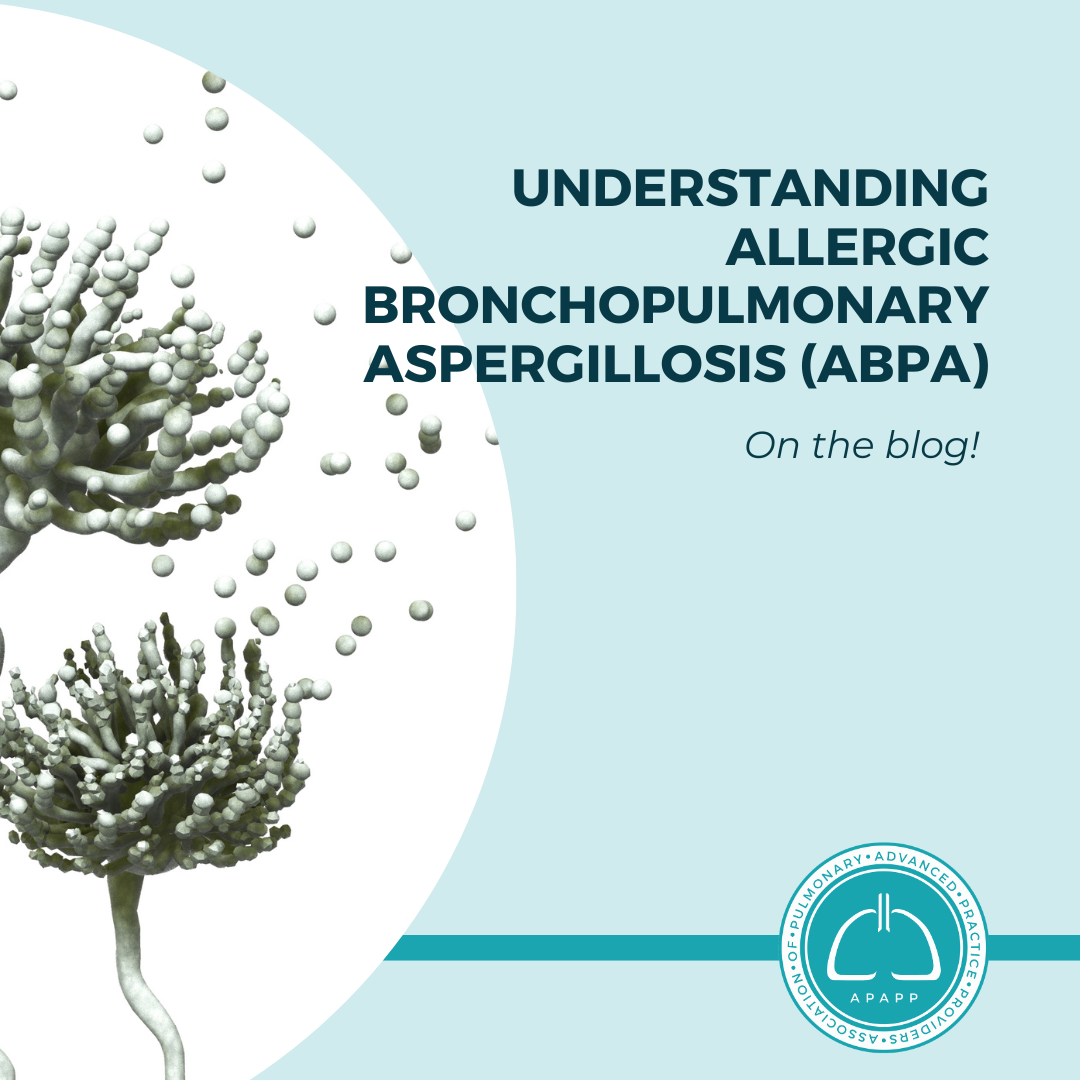
Allergic Bronchopulmonary Aspergillosis (ABPA) is a hypersensitivity reaction to the colonization of the airways by the fungus Aspergillus fumigatus, characterized by persistent pulmonary symptoms, radiographic changes, and elevated inflammatory markers (Akuthota & Weller, 2025a). ABPA is found in patients with the following underlying chronic lung conditions: asthma, cystic fibrosis (CF), or more rarely COPD. Patients with these underlying chronic lung conditions are ideal hosts for colonization of the fungal spores, which are found in soil. If patients have persistent symptoms, such as dyspnea, coughing, or wheezing, despite being on maximum inhaler therapy, it should prompt APPs to investigate for ABPA as a cause of these patients’ uncontrolled respiratory symptoms.
Symptoms of ABPA are those symptoms seen in exacerbations of asthma and cystic fibrosis. Most commonly, a productive cough though, may also have fever and hemoptysis. Diagnosis of ABPA is defined by the International Society for Human and Animal Mycology (ISHAM) 2024 guidelines as follows: patient must have a predisposing condition (most commonly, asthma or CF) plus an Aspergillus fumigatus IgE >0.35 kU/L and a serum IgE concentration > 500 IU/mL (Agarwal R et al, 2024). In addition to those three requirements, a patient must have two of the following laboratory markers’ Aspergillus fumigatus IgG >27, peripheral eosinophilia >500 cell/ microL (does not have to be this level at time of diagnosis; can be a historical value), or CT imaging consistent with ABPA (Agarwal R et al, 2024), sometimes called “finger in glove” distribution. This includes bronchial central bronchiectasis and intermittent centrilobular nodular opacities (UTD), both due to mucus impaction and resultant inflammation.
Once diagnosed with ABPA, treatment is tailored based on timeline of disease. In acute ABPA cases, when there is significant inflammation as evidenced by opacities on CT and serum IgE >1000 IU/ L, the ISHAM recommends starting on oral glucocorticoids (Akuthota & Weller, 2025b). While the optimal dose is not defined, patients are generally started on prednisone 0.5 mg/ kg daily for at least 14 days (Akuthota & Weller, 2025b). Duration and tapering recommendations are based on the decrease in serum IgE levels (Akuthota & Weller, 2025b). Serum IgE should decrease at least 25% in the first month and 60% by the end of the second month (Akuthota & Weller, 2025b). Patients will likely need oral glucocorticoid therapy tapered over a span of three months (Akuthota & Weller, 2025b). Antifungal therapy is added for patients who are unable to taper oral glucocorticoids without returning symptoms, who have exacerbations of their underlying airway disease, or increase in the serum IgE despite oral Glucocorticoids (Akuthota & Weller, 2025b). Both voriconazole or itraconazole can be used, but voriconazole is preferred as it is better tolerated (Akuthota & Weller, 2025b). Both medications are continued for a course of 16 weeks (Akuthota & Weller, 2025b). If a patient has taken a course of antifungal therapy and is still unable to taper off oral glucocorticoids, it is best practice to add biologic therapy such as anti-IgE agents (omalizumab), anti-IL5 agents (mepolizumab or benralizumab), or anti-IL4 agents (dupilumab) (Akuthota & Weller, 2025b)
The data surrounding the introduction of biologic therapy in ABPA has historically been limited; however, recent studies are evolving to show benefit in conjunction with other therapies. Biologic therapy may prove especially beneficial in patients with asthma by targeting underlying airway inflammation. There is the most available data on omalizumab in ABPA: A meta-analysis of 86 studies involving over 300 patients was conducted by Chen et. Al (2024). This was also seen in a review article from The Journal of Allergy and Clinical Immunology in March 2023, which analyzed 50 studies and found that omalizumab reduced glucocorticoid use and even improved lung function by an 11.9% increase in FEV1.
There are some studies focused on dupilumab and mepolizumab, but available data suggest clinical benefit from these biologics in ABPA management. These were statistically significant in their reduction of oral glucocorticoid dosing and IgE levels. One case report from Respiratory Medicine Case Report in 2022 discussed a patient who was switched from mepolizumab to dupilumab with improvement in clinical and diagnostic markers. Benralizumab also appears to reduce glucocorticoid dosing and IgE levels, but was not statistically significant. Currently though, there are no FDA-approved biologic therapies for ABPA.
If an APP sees a patient in an outpatient or inpatient setting who describes symptoms of persistent dyspnea, productive cough, and wheezing despite being on guideline-directed inhaler therapy, it is important to add ABPA to a differential as well. Using the above diagnostic criteria provides well-outlined guidelines to diagnose patients with ABPA. While many of our pulmonary patients describe symptomatic relief from short courses of oral corticosteroids, it is important to be mindful of the timeline, as this temporary relief could be an indication of the anti-inflammatory effect on the hypersensitivity reaction of ABPA. While more often managed in the outpatient setting, it is important for inpatient providers to be mindful of this condition, as prompt diagnosis can help prevent complications such as chronic pulmonary aspergillosis, aspergillomas, and respiratory failure.
Written by Nicole Geer, PA., Jennifer C Weber, APRN, Stephanie Bork, APRN
Edited by Sara Kraus, ARNP,
References:
Akuthota, P., & Weller, P. (2025a). Clinical manifestations and diagnosis of allergic bronchopulmonary aspergillosis. UpToDate. https://www.uptodate.com/contents/clinical-manifestations-and-diagnosis-of-allergic-bronchopulmonary-aspergillosis?search=abpa&source=search_result&selectedTitle=1~53&usage_type=default&display_rank=1
Akuthota, P., & Weller, P. (2025b). Treatment of allergic bronchopulmonary aspergillosis. UpToDate. https://www.uptodate.com/contents/treatment-of-allergic-bronchopulmonary-aspergillosis?search=abpa+patho&source=search_result&selectedTitle=1~55&usage_type=default&display_rank=1
Agarwal R;Sehgal IS;Muthu V;Denning DW;Chakrabarti A;Soundappan K;Garg M;Rudramurthy SM;Dhooria S;Armstrong-James D;Asano K;Gangneux JP;Chotirmall SH;Salzer HJF;Chalmers JD;Godet C;Joest M;Page I;Nair P;Arjun P;Dhar R;Jat KR;Joe G;Krishnaswamy UM;Mathew J. (2024). Revised Isham-ABPA Working Group Clinical Practice Guidelines for diagnosing, classifying and treating allergic bronchopulmonary aspergillosis/mycoses. The European respiratory journal. https://pubmed.ncbi.nlm.nih.gov/38423624/
Chen, X., Zhi, H., Wang, X. et al. Efficacy of Biologics in Patients with Allergic Bronchopulmonary Aspergillosis: A Systematic Review and Meta-Analysis. Lung 202, 367–383 (2024). https://doi.org/10.1007/s00408-024-00717-y
Jin, M., Lazarewicz, S., Jaumont, X., Yan, M., Calhoun, W., Agarwal, R., Elborn, J., & Douglass, J. (2023, March). Omalizumab in Allergic Bronchopulmonary Aspergillosis: A Systematic Review and Meta-Analysis. JACI in Practice. https://www.jaci-inpractice.org/article/S2213-2198(22)01325-3/fulltext
Respiratory Medicine Case Report
2022 Aug 17:39:101723.
doi: 10.1016/j.rmcr.2022.101723.